


Breathwork, cold plunges, and saunas are having a moment.
Is the science there to match the hype?
By Matt Freemantle
Contrast therapy has gone from fringe ritual to part of an essential wellbeing routine for many people. In major cities globally you can now book sauna and cold plunge sessions as easily as a yoga class. But past the hype, what is the point exactly and how does it all work?
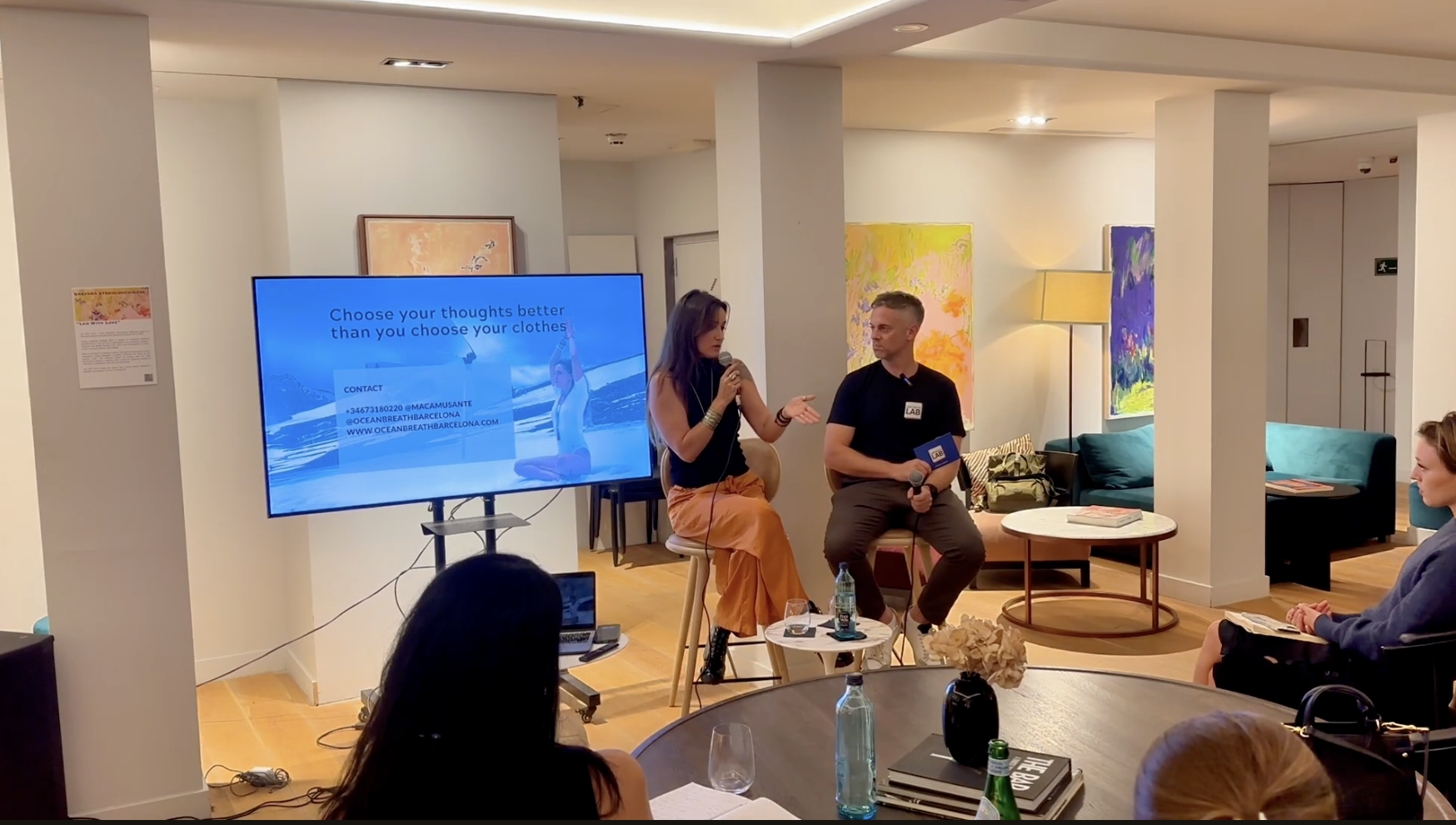
During a Growth Lab LIVE in Barcelona last year, with Founder of Ocean Breath Barcelona, Macarena Musante, we delved into the facts and findings. Why is contrast therapy increasingly being used as a tool for training the body’s stress response?

Macarena leading a cold plunge session
Cold therapy is pure physiology
Macarena Musante starts with what most people notice first; hands. Cold water triggers vasoconstriction, and the extremities pay the price. “Because of the vasoconstriction… the hands are the first part of our body that loses the blood. So, it’s very painful,” she says.
Instead of toughing it out, she offers a practical workaround. “I like to do it with the hands inside. You can put them on your belly… to keep them a little bit warm,” she explains.
And she is clear about progressive exposure. “If it’s too painful… get your hands out and put it on the last 30 seconds because the idea is that you train also your hands to get better circulation.” Her point is not to avoid discomfort. It is to dose it. “Do it gradually if it’s too painful. You don’t have to do the full… with your hands if it’s too much.”
That approach matches where the broader evidence is landing. A 2025 systematic review of cold-water immersion found “time-dependent effects” across outcomes like stress, sleep quality, and quality of life, but also stressed that the evidence base is still limited by small trials and a lack of diverse study populations.
So yes, it can help but no, it is not magic. The dosage matters, and the reason you are doing it matters even more.
wait for four hours if weight training
Musante’s advice for people training for strength or hypertrophy is separating cold exposure from workouts if you are trying to build muscle. “If you’re training, wait four hours… Try not to do it together if you’re building muscle,” she says.
But if your context is impact sport recovery, the calculus changes. “If it’s for recovery, for pain after competition, rugby, whatever. Yes, go for it.”
A cold plunge after a heavy squat session is not quite the same thing as a cold plunge after a match, or after a long run when you are simply trying to feel human again the next morning and eliminate aches and pains.
Breathwork can be activated anywhere
Your breathing patterns can be subtle, which is why it is easy to underestimate their importance. Musante frames breathwork as an important skill that changes your nervous system state.
The science is increasingly aligned with this “breath as a lever” idea. A 2022 systematic review and meta-analysis found voluntary slow breathing increases vagally mediated HRV, a commonly used marker of parasympathetic activity. And in a 2023 study in Cell Reports Medicine, brief daily structured breathing practices improved mood, with breathwork outperforming mindfulness meditation in that trial.
She also normalises the weird sensations that put beginners off. “This is just tension accumulated… during the years.”Musante’s advice is practical, especially for people who get intense hand sensations. “This usually happens on the first breath works. These sensations usually disappear with time,” she says. “As soon as you breathe through your nose, it will disappear.”
Breath holds, CO2 tolerance, and the “mind sport” angle
Should we talk about breath holds the way a coach talks about training blocks? “It’s something you train. You build that CO2 tolerance,” she says.
It can be linked to free-diving, where performance depends on staying calm under pressure. “Free diving is actually a very mental sport. You need to control your relaxed response. You need to choose to be in the parasympathetic to consume less oxygen.”
The takeaway for normal life is obvious. If you can practise calm when your body wants to panic, that transfers into your day to day easily.
should you do breathwork every day?
Musante is relaxed about frequency. “You can do breath work on daily basis. No problem,” she says. But she also acknowledges that certain practices can trigger emotional release, which is not always what you want on a random Tuesday. “I was doing breath work on a daily basis. I was going through a divorce… going through a lot of emotions,” she explains. Now she mixes methods. “I combine different breathing techniques… because I don’t want every day to have such an emotional release.”
Her advice is simple and adult. Test, adapt, keep what works. “Change it. See how it works… what works for you.”
For running, she draws a clear boundary. “I wouldn’t do it because breath work actually… makes you a little bit dizzy,” she says, suggesting breath-hold style practice instead.
Sauna can be powerful if used correctly
On heat, Musante is bullish. “Saunas are great… for your longevity,” she says. Observational research backs the direction of that claim even if it cannot prove causation. A large Finnish cohort study published in JAMA Internal Medicine reported that more frequent sauna bathing was associated with reduced risk of sudden cardiac death and all-cause mortality.
But she pushes back on the most fashionable version of contrast therapy, the instant jump from ice to sauna. “You will miss some of the benefits of the ice bath if you jump to a sauna straight away,” she says. Her preferred bridge is thermogenesis, letting your body generate its own heat. “The idea is you create your own heat… With movement this is called thermogenesis.”
A quick safety note that deserves to be loud
Musante’s core guidance inside the ice bath is parasympathetic breathing. “We want to be chill in a stress situation… box breathing… just breathing through the nose in and out etc.”
This is not just comfort, it is also safety. Wim Hof Method guidance explicitly warns to breathe normally during cold exposure involving water, and not to do the breathing exercise there due to fainting and drowning risk. Wim Hof Method Lifesaving organisations also warn against hyperventilation before breath-holding because it can increase blackout risk.
To watch the full Q&A head over to our Youtube channel on the link below!